I am excited to share that the complete manuscript of LLM Customization and Fine-Tuning: Adaptation, Distillation, and Alignment, written with Weehyong Tok , is now in Early Access from Manning Publications . 📚 When I announced the book in July , readers had the first five chapters. This update adds the four chapters that take you from a fine-tuned adapter to a model you can run, trust, and keep running in production.
The July post covers why we wrote the book and who it is for. This one is about what you can do after you finish it, because the second half is where the techniques that make the biggest difference in production live.
What the second half gives you
Chapter 6: fine-tune the whole model, and know when you should. You train every parameter of the model on your own data, on hardware you can get, and you come away able to read a training run the way an experienced practitioner does: what a healthy loss curve looks like, which warning signs mean stop, and how to catch a regression before it reaches a user. You also get the decision we are asked about most often, when full fine-tuning is worth its cost over a LoRA adapter, answered with a side-by-side run rather than an opinion. The chapter shows the same job on Azure OpenAI and Vertex AI, and closes with a real project costed from first experiment to deployment.
Chapter 7: capture a frontier model’s behavior in a model you own. Distillation trains a smaller, cheaper student to reproduce a stronger teacher’s behavior. You build the pipeline end to end, from generating and filtering teacher answers to training and scoring the student. You see how close a small model can get: ours kept 98% of its teacher’s quality and reproduced the teacher’s answer format on every held-out prompt. You also learn the lesson that catches teams by surprise: safety doesn’t come along for the ride, and you leave with a test that proves whether your student is safe to ship. The cost model tells you when distillation pays back and when the API is the better deal.
Chapter 8: teach the model to prefer the better answer. Supervised fine-tuning shows a model what a good answer looks like; preference optimization shows it two answers and which one people chose. You run DPO on real human-graded pairs and on a conciseness dataset, and you see exactly what each buys: shorter answers that a blinded judge preferred, with correctness intact, and no change at all on the axis you did not train. That is the most useful thing to know about alignment before you spend a week on it. The chapter then takes you through GRPO, RLHF, and reinforcement fine-tuning with verifiable rewards, tells you plainly which few teams need them, and ends with a safety check after alignment.
**Chapter 9: Keep the model working after launch. **** Deploying a model starts a new kind of work, and this chapter equips you for it. You build a model and data registry that can answer an auditor’s question in minutes, a drift detector with canary prompts, a rollback you can execute inside an hour, a red-team safety monitor that runs on a schedule, and the triggers that tell you when to retrain and when to leave the model alone. The chapter ends with a year in the life of the book’s IT-support model, two retrains and one rollback included, so you see the whole loop run before you have to run it yourself.
The whole book, end to end
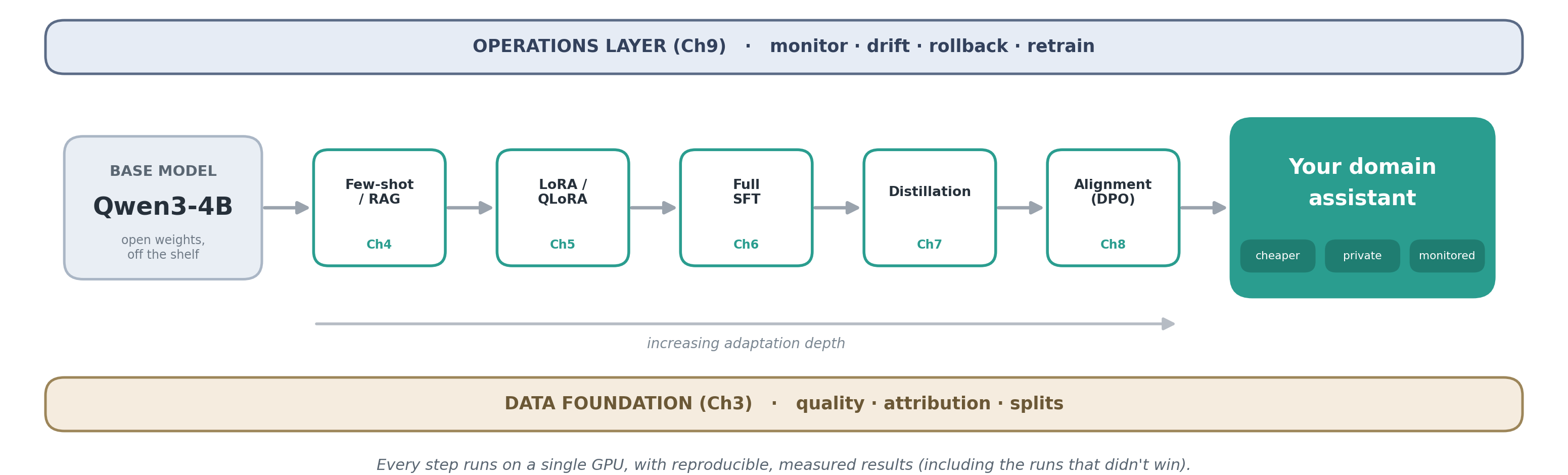
With these four in place, the book does what we set out to do. One model, Qwen3-4B-Instruct-2507, and one real IT-support dataset carry a single help-desk assistant from few-shot prompting and RAG, through LoRA and QLoRA, full fine-tuning, distillation, and DPO alignment, into a monitored deployment. The data chapter comes first because data drives the result, and a framework for choosing between techniques on cost, latency, privacy, and return on investment runs through every chapter. Because the model, data, and task never change, you compare techniques on equal terms and leave knowing which one your project needs.
What you will be able to do
- Choose the right technique for a real use case, with a cost, latency, privacy, and ROI framework instead of a guess.
- Build the training data, from curation and quality gates to teacher-generated examples, with lineage you can defend.
- Fine-tune on a single GPU with LoRA and QLoRA, then step up to full fine-tuning when the evidence says to.
- Distill a frontier model’s behavior into a model you own, and prove the student is safe.
- Align a model with DPO and measure what alignment changed, with safety tested before and after.
- Run the model in production with versioning, drift detection, rollback, scheduled safety monitoring, and a retraining cadence.
Every result in the book comes from a run you can repeat on hardware you can get, and the techniques apply unchanged to the far larger models most enterprises deploy.
Explore the code
The book’s GitHub repo includes runnable code for every chapter, prepared datasets, trained models on Hugging Face, and training and evaluation logs, including failed runs, with validation across NVIDIA, AMD, and Apple Silicon. Explore it at github.com/bahree/ModelAdaptationBook , and pull the models from Hugging Face if you would rather run inference than train.
Get your copy
The manuscript is complete and heading to production, so if you buy the Early Access edition today, you get the whole book now and every update through the final version. Order LLM Customization and Fine-Tuning from Manning in your preferred format, and if you already have it, the new chapters are waiting in your library.
Thank you to Weehyong for co-writing it, to Rebecca Johnson at Manning for editing every chapter, and to the readers in the liveBook forum whose questions shaped the second half.
We cannot wait to see what you build.
With gratitude 💚
Five chapters in July, then four more, Fine-tune, distill, align, and keep score; One model, one task, And the logs, if you ask, Now the whole of the book is out the door.